

#12 | Gen Z is NOT Tech-Savvy
The new generation is often described as “tech-savvy.” But what does it really mean?

In this article, I argue that the assumption that Gen Z is tech-savvy is misleading and that the truth is more complex. I'll explore how the term “tech-savvy” can be defined, the challenges that Gen Z (born between 1997 and 2012) faces with digital literacy, and the importance to consider these nuances when designing learning experiences with new technologies.
Defining Tech-Savviness
First, let's clarify what we mean by "tech-savvy." This term typically alludes to either digital literacy or digital fluency, as defined here:
Digital literacy, as defined by the American Library Association, refers to an individual’s “ability to use information and communication technologies to find, evaluate, create, and communicate information, requiring both cognitive and technical skills.”
Digital fluency, as defined by The Nelson A. Rockefeller Institute of Government, means “having the skillset and understanding of digital technology to not only use it for basic tasks but also to adapt different digital tools for different situations to achieve a desired outcome such as creating new information and content”.
This article focuses on highlighting the misconception surrounding Gen Z’s digital literacy, encompassing digital fluency as an advanced facet of it.
Digital Consumption vs Digital Literacy
First of all, digital literacy assumes access to technology. Unfortunately, a non-negligible portion of the population, including Gen Z, still lacks access to essential devices, a point that I cover more in depth in the article “First, Accessibility.” This digital divide creates early challenges in acquiring the skills needed to navigate the digital world effectively and safely.
For those with access, becoming "tech-savvy" demands more than just spending endless hours on your phone or computer. Let’s have a look at how the OECD defined the different levels of skills when it comes to digital literacy:
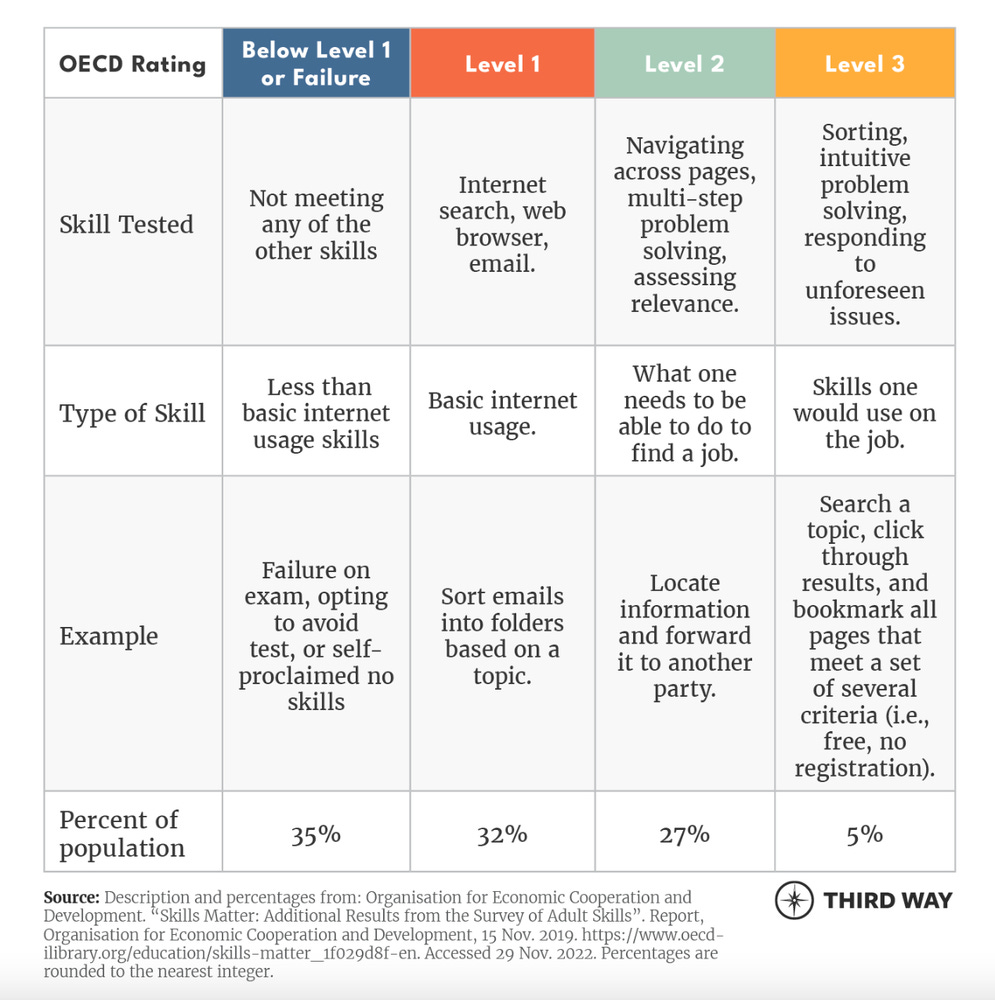
According to this OECD report, in 2019, 67% of American adults lacked the skills needed for finding a job online, which involve advanced internet navigation, problem solving and critical understanding of information. On the other end, another study showed that 79% of Americans used social media this same year.
This overlap illustrates the disconnect between merely using digital tools and demonstrating digital literacy, which holds true for Gen Z.
Being Born with Technology vs Growing Up with Technology
Millennials (born between 1981 and 1996), like myself, grew up alongside the emergence of technology, gradually learning as computers, phones, and other devices evolved. This hands-on experience provided us with a deeper understanding of technology's progress and inner workings. In contrast, Gen Z has grown up with sophisticated tools and optimized user experiences, requiring minimal effort to grasp their functionality.
Our generation faced challenges like monitoring and maximizing internet usage, navigating complex software to download - illegal - content, and inventing text shortcuts to save characters out of necessity. While we aren't immune to online misinformation or scams, I believe these experiences helped us be more critical online, as well as more patient and resourceful when unexpected issues arise.
Conversely, Gen Z's expectations for seamless technology, along with a reduced exposure to some forms of productive struggles when using digital tools, creates an environment where learning the skills required to develop digital literacy doesn't naturally occur.
Creators vs Consumers
Gen Z is highly proficient with smartphones but often struggles with more traditional computing tasks. In my conversations with educators in higher education, many mentioned that their students were challenged with basic skills such as working with multiple browser windows or managing their emails.
This isn’t due to incapability but stems from their habit of using technology as consumers rather than creators. As a counterexample, many streamers on Twitch learned in depth how hardware and software work to produce great quality sound and image and leverage interactivity with their communities. They needed these skills and knowledge to create content. However, creators like them only represent a minor part of the population.
Consider the analogy between cars and digital tools: some build them, some are enthusiasts, but the vast majority uses them without understanding what’s under the hood. However, technology’s complexities and threats are far greater and much less apparent. Generative AI is a great example as only a few thousand people in the world truly understand how large language models and associated algorithms work, yet its impact and the associated risks are already immense.
Risks of Lack of Digital Literacy
Jobs
While digitalization currently impacts seniors the most, Gen Z will likely face substantial changes when entering the job market. Many existing jobs are already being influenced by AI. According to the Pew Research Center, 19% of US workers currently work in a position in which the most important activities may be either replaced or assisted by AI. They are particularly represented in higher-paying fields.
The new generation will not only compete with AI but also with experienced professionals who can leverage new tools effectively. In order to succeed in white-collar jobs, they must proactively develop their technological skills. In fact, they can’t expect traditional schooling to provide them with the required knowledge, as technology is currently evolving faster than curriculums and educators’ training.
Bridging the gap between their general education and their self-acquired technological expertise will be crucial for their job market relevance. Unfortunately, this challenge may exacerbate existing equity gaps, as those with access to resources and support for informal and formal tech education will have be heavily advantaged. It will also create social and economical tension with new graduates struggling to find a job in adequacy with their degrees.
Online risks
Insufficient digital literacy also exposes Gen Z to online risks.
A 2019 survey conducted by the Pew Research Center found that while most Americans can correctly answer questions about phishing scams (67 percent), website cookies (63 percent), and online advertising (59 percent), far fewer understood topics such as privacy policies (48 percent), website encryption security (30 percent), two-factor authentication (28 percent), and private browsing mode (24 percent).
The rise of generative AI amplifies these risks, as it allows for increasingly convincing manipulation of texts, images, sounds, and videos. Developing critical thinking and learning good practices to identify misinformation has become crucial, especially on social media.